Healthcare Use Cases via LowCode Platform
- GHIT Digital
- August 14, 2025
- GHIT Digital Insights
- 0 Comments
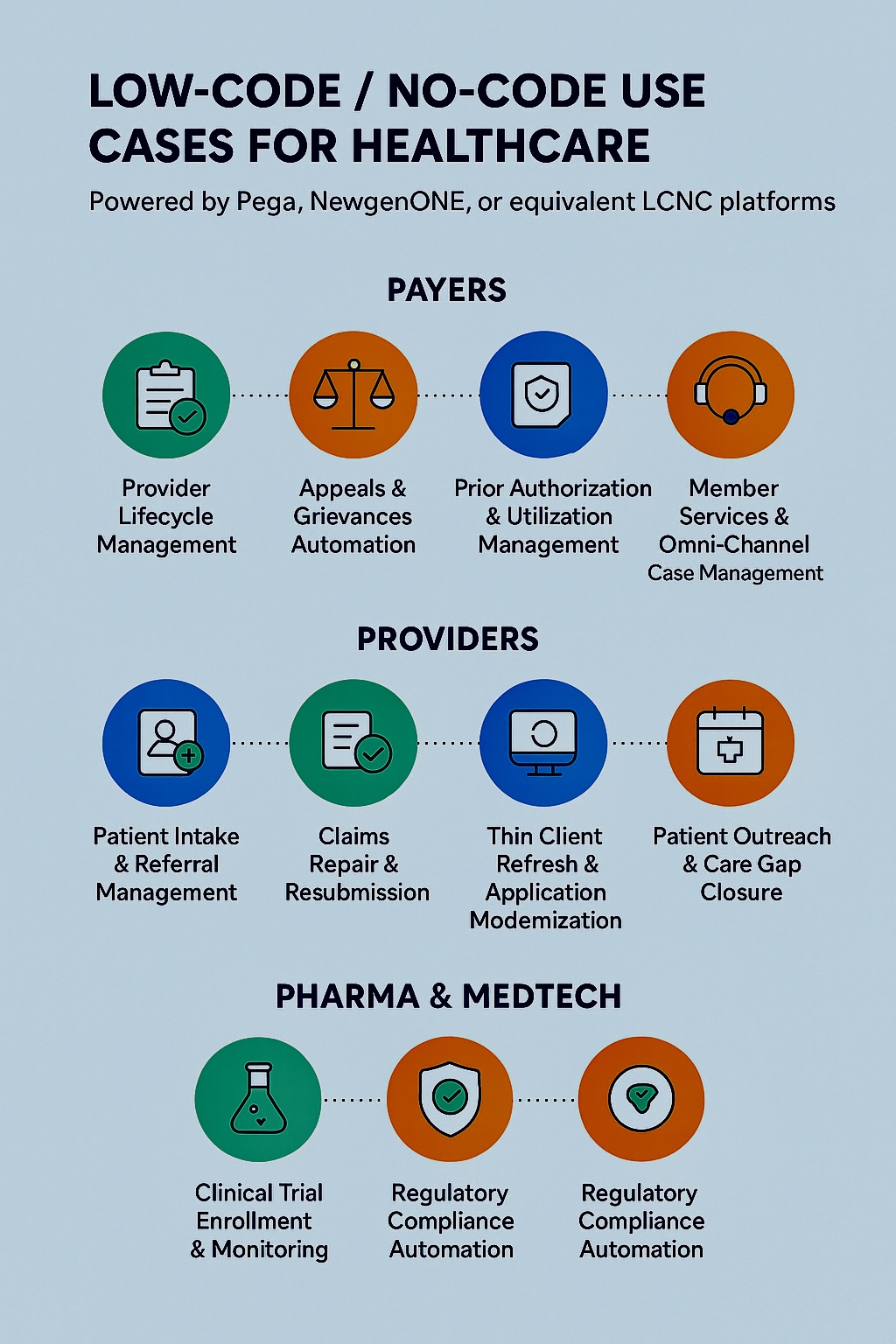
Low-Code / No-Code Use Cases for Healthcare
(Payers, Providers, Pharma & MedTech)
???? Powered by Pega, NewgenONE, or equivalent LCNC platforms
???? Aligned with workflow automation, deployment, and adoption best practices
1. Provider Lifecycle Management (Payers)
Objective: Automate provider onboarding, credentialing, and contract management.
Low-Code Impact:
- Drag-and-drop workflow creation to collect provider documents, verify credentials (via API integrations with CAQH, NPPES, OIG lists), and trigger approval steps.
- Dynamic rules engine to adjust onboarding steps by provider type (Physician, Specialist, Allied Health).
- Self-service portals for providers to upload credentials and track status.
Business Benefits:
- Reduced onboarding time from months to weeks.
- Compliance assurance via automated checks.
- Single unified view of provider profiles.
2. Appeals & Grievances Automation (Payers & Providers)
Objective: Meet CMS timelines for A&G while improving resolution quality.
Low-Code Impact:
- Prebuilt templates for intake, classification, and routing of appeals.
- SLA-driven workflows with escalation triggers.
- Role-based dashboards for case managers.
Business Benefits:
- Regulatory compliance with minimal manual tracking.
- Faster closure rates with reduced errors.
- Improved member satisfaction.
3. Patient Intake & Referral Management (Providers)
Objective: Digitize and automate patient registration, consent forms, and referral processing.
Low-Code Impact:
- EHR-integrated intake forms that auto-populate patient demographics.
- Rules-based routing of referrals to in-network providers or specialists.
- Real-time notifications to patients and referring physicians.
Business Benefits:
- Elimination of paper-based delays.
- Better network utilization.
- Enhanced patient experience from day one.
4. Prior Authorization & Utilization Management (Payers & Providers)
Objective: Reduce manual review of prior authorizations while ensuring compliance with payer policies.
Low-Code Impact:
- AI-assisted decision trees to approve common requests instantly.
- Integration with clinical guidelines (e.g., MCG, InterQual).
- Automated member/provider notifications on decision status.
Business Benefits:
- Reduced turnaround from days to hours.
- Lower administrative costs.
- Consistent decision-making.
5. Member Services & Omni-Channel Case Management (Payers)
Objective: Provide a unified service experience across phone, web, chat, and mobile.
Low-Code Impact:
- LCNC-created omni-channel service portal.
- Single case record for each member interaction.
- Automated follow-up workflows triggered by case type.
Business Benefits:
- Increased first-call resolution rates.
- Reduced call center handle time.
- Member loyalty through personalized service.
6. Clinical Trial Enrollment & Monitoring (Pharma & Life Sciences)
Objective: Simplify patient recruitment and engagement for trials.
Low-Code Impact:
- Configurable portals for patient screening & consent capture.
- Automated trial milestone tracking & reporting to regulatory bodies.
- Secure messaging between trial coordinators and participants.
Business Benefits:
- Faster patient recruitment.
- Regulatory-ready audit trail.
- Improved trial retention rates.
7. Claims Repair & Resubmission (Payers & Providers)
Objective: Reduce claim denials and speed up payments.
Low-Code Impact:
- Automated detection of missing/incorrect claim data.
- Guided correction workflows for claims specialists.
- Integration with clearinghouses for resubmission.
Business Benefits:
- Reduced AR days.
- Lower rework effort.
- Better payer-provider relationships.
8. Thin Client Refresh & Application Modernization
Objective: Upgrade outdated applications to LCNC-enabled thin clients for better user adoption.
Low-Code Impact:
- Rapid migration of legacy screens to responsive UI components.
- Automated deployment pipelines with minimal coding.
- Built-in training workflows embedded in the app.
Business Benefits:
- Faster rollout with less IT overhead.
- Improved user experience across devices.
- Lower long-term maintenance cost.
9. Patient Outreach & Care Gap Closure (Payers & Providers)
Objective: Close preventive care gaps and improve quality scores (HEDIS, Stars).
Low-Code Impact:
- Automated patient lists based on care gap data.
- Configurable outreach workflows (SMS, email, calls).
- Integration with appointment scheduling tools.
Business Benefits:
- Higher quality ratings.
- Better population health outcomes.
- Increased incentive payments from CMS.
10. Regulatory Compliance Automation
Objective: Ensure compliance with HIPAA, CMS, FDA, and other regulations.
Low-Code Impact:
- Prebuilt audit workflows for data access, breach reporting, and compliance attestations.
- Automated reminders for compliance training.
- Role-based access controls built into workflows.
Business Benefits:
- Reduced regulatory risk.
- Centralized compliance reporting.
- Higher audit pass rates.
???? Implementation Pattern:
For each use case, the Pega Low-Code Specialist (or similar LCNC SME) can:
- Configure business rules, forms, and integrations without deep coding.
- Deploy in sprints for faster adoption.
- Train business teams using embedded guided workflows.
- Iterate quickly based on feedback.